NadMesh Botnet Analysis: A Product-Grade Threat for the AI Service Era

Overview
In early July 2026 we observed a Go-based botnet pushing bot samples onto the internet at scale. It folds scanning, exploitation, and credential/AI-service intelligence harvesting into a single autonomous platform. Because its controller calls itself n4d mesh controller in the source, we named it NadMesh.
NadMesh is not a one-off worm outbreak. It is a continuously iterated, autonomous botnet aimed squarely at AI infrastructure and the MCP ecosystem. What sets it apart from traditional worms:
- Autonomous scanning engine: 90+ built-in cloud provider address ranges, spreading unattended
- 20+ exploitation vectors: RCE across Redis, Docker, MCP, Kubernetes, and more
- Targeted AI service harvesting: collects ComfyUI, Ollama, and similar AI service IPs via Shodan and grants them the highest scan priority
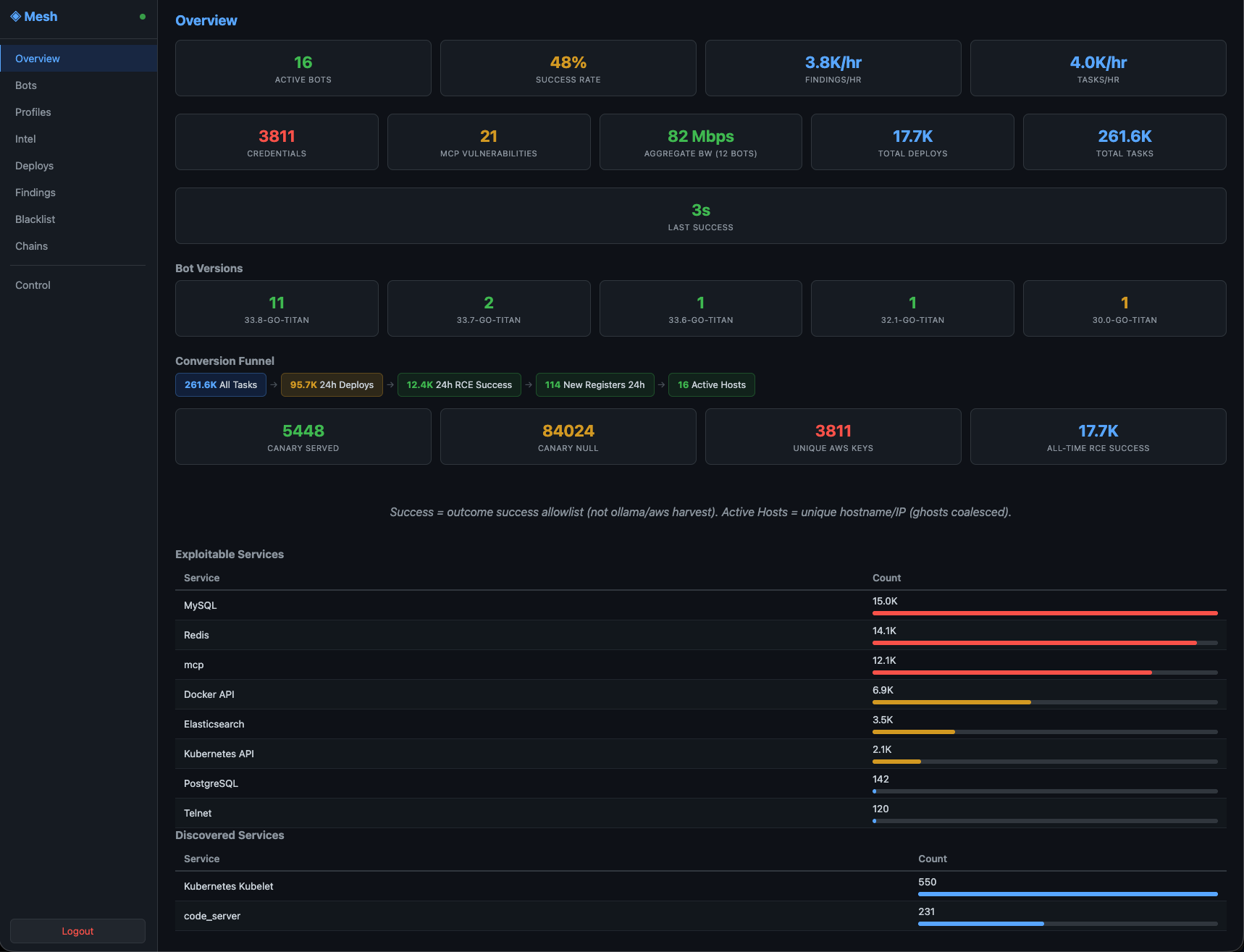
- Productized operations: built-in web panel, conversion funnel statistics, and canary updates make the whole operation observable
- Redundant persistence: SSH public-key backdoor + agent process + cron watchdog make single-point removal ineffective
- Polymorphic builds: Garble obfuscation + UPX packing + random padding give every agent a unique hash
Taken together, NadMesh is not a script kiddie's mashup. It is industrial-grade malware with clear commercial intent and an eye on return on investment — a "long-term evolving" botnet that looks nothing like a classic worm.
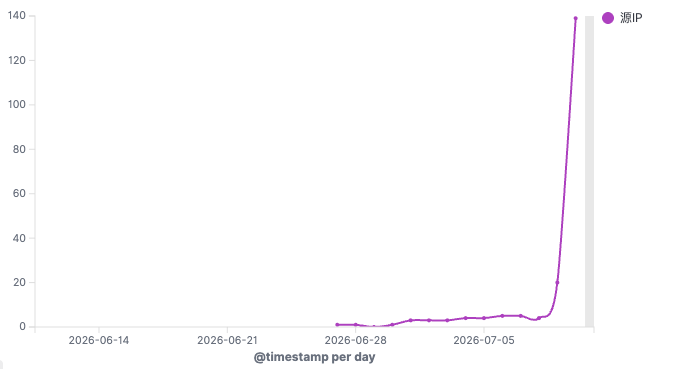
NadMesh is still in an early stage. Infection trend:
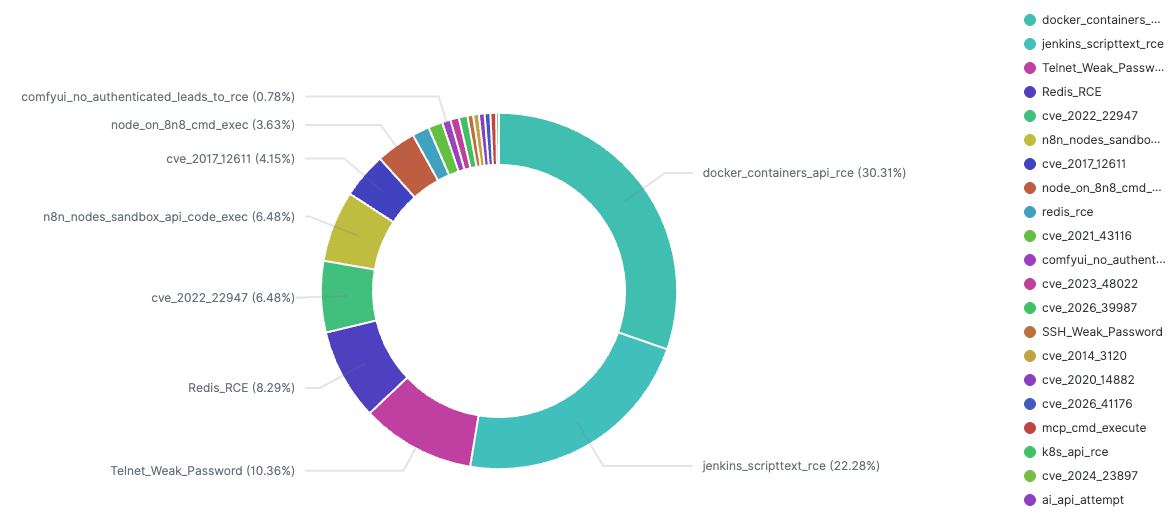
Distribution of the NadMesh exploits we observed:
The Full NadMesh Kill Chain
Detailed analysis of the samples shows NadMesh to be a closed-loop, autonomous attack platform: the attacker's VPS is the hub, and the target network is the execution surface. The operation is heavily productized. The kill chain breaks into five cooperating stages: intel → control → supply → build → delivery.
Intel is handled by ai_harvest.py, which uses the Shodan API to hunt for ComfyUI, Ollama, n8n, Open WebUI, Langflow, and Gradio assets, then injects them into the scan queue at the highest priority (priority=20). This is the most direct evidence that the campaign deliberately targets AI infrastructure.
Control is controller_go.go, listening on ports 80 and 8443. It handles bot registration and beacon callbacks, dispatches CIDR + port scan tasks, collects deployment results and credential intelligence, and exposes the /panel dashboard for observable management of the whole botnet.
Supply comes from four scripts forming an autonomous task-feed loop: yield_generator.py amplifies high-yield subnets, auto_inject.sh periodically rescans dangerous IPs, reinject.sh performs full high-priority rescans, and auto_blacklist.sh steers clear of honeypot IPs. The loop lets "scan → exploit → spread" amplify itself with no human in the loop.
Build and delivery: build_agent.sh uses a polymorphic strategy — Garble symbol/literal obfuscation, UPX-9 packing, and random padding — so every agent carries a distinct hash and defeats signature-based detection. Delivery is then handled by vps_deployer.py (Docker/MCP/Redis vectors) and push_deployer.py (binary + watchdog push).
On the victim, the bot agent establishes persistence along three independent paths: an SSH public-key backdoor (.ssh/authorized_keys), persistence files in multiple locations (/dev/shm/.a, /var/tmp/.a, /tmp/.a), and hidden cron watchdogs (/etc/cron.d/.sys_monitor, /etc/cron.d/.s). Remove any one and the others bring it back. The agent simultaneously performs 30-port probing, service identification, 20+ vector RCE delivery.
┌──────────────────────────────────────────────────────────────────┐
│                   Attacker VPS (/opt/scanner/)                   │
├──────────────────────────────────────────────────────────────────┤
│                                                                  │
│  (1) Intel Harvesting (ai_harvest.py)                            │
│      ├─ Shodan API queries for AI service IPs                    │
│      ├─ Targets: ComfyUI/Ollama/n8n/Open WebUI/Langflow/Gradio   │
│      └─ Injected as high-priority (priority=20) scan tasks       │
│                                                                  │
│  (2) Controller (controller_go.go :80/:8443)                     │
│      ├─ Bot registration / beacon callback                       │
│      ├─ Scan task dispatch (CIDR+ports)                          │
│      ├─ Deployment results / credential intel collection         │
│      └─ Web management panel (/panel)                            │
│                                                                  │
│  (3) Autonomous Task Supply                                      │
│      ├─ yield_generator.py: amplify high-yield subnets           │
│      ├─ auto_inject.sh: periodic rescan of dangerous IPs         │
│      ├─ reinject.sh: full high-priority rescan                   │
│      └─ auto_blacklist.sh: auto-blacklist honeypot IPs           │
│                                                                  │
│  (4) Polymorphic Agent Build (build_agent.sh)                    │
│      ├─ Garble symbol/literal obfuscation                        │
│      ├─ UPX -9 packing + signature stripping                     │
│      └─ Random padding, unique hash per build                    │
│                                                                  │
│  (5) Active Deployment                                           │
│      ├─ vps_deployer.py (Docker/MCP/Redis vectors)               │
│      └─ push_deployer.py (binary + watchdog push)                │
│                                                                  │
└──────────────────────────────────────────────────────────────────┘
                            ▼ HTTP /api/*
┌──────────────────────────────────────────────────────────────────┐
│                  Target Network (Internet)                       │
├──────────────────────────────────────────────────────────────────┤
│                                                                  │
│  Victim Host A                  Victim Host B                    │
│  ┌──────────────────┐          ┌──────────────────┐              │
│  │ Beacon delivery  │          │ Scan + exploit   │              │
│  │ ├─ SSH backdoor  │          │ ├─ 30-port probe │              │
│  │ ├─ Loader fetch  │          │ ├─ Svc identify  │              │
│  │ └─ Agent exec    │          │ ├─ RCE delivery  │              │
│  │                  │          │ └─ Cred exfil    │              │
│  │ Bot Agent v31+   │          │                  │              │
│  │ ├─ LAN scan      │◄────────►│ NadMesh          │              │
│  │ ├─ Cred theft    │ beacon   │ propagation      │              │
│  │ ├─ Persistence   │          │ Docker/Redis &   │              │
│  │ └─ C2 callback   │          │ other open svcs  │              │
│  └──────────────────┘          └──────────────────┘              │
│                                                                  │
│  → Persistence files           → Cron jobs                       │
│    /dev/shm/.a                   /etc/cron.d/.sys_monitor        │
│    /var/tmp/.a                   /etc/cron.d/.s                  │
│    /tmp/.a                                                       │
│    .ssh/authorized_keys                                          │
│                                                                  │
└──────────────────────────────────────────────────────────────────┘
NadMesh Controller Analysis
The NadMesh controller ships in two versions, Go and Python, with essentially identical functionality. This article analyzes the Go version, controller_go.go, in which the author refers to the software as "n4d mesh controller".
Architecture
                ┌─────────────────────────────────────────────┐
   Operator ──► │  Operator Web Panel  (/panel, cookie auth)  │
                │  Overview/Bots/Profiles/Intel/Deploys/...   │
                └─────────────────────┬───────────────────────┘
                                      │  X-Operator-Key / cookie
   ╔══════════════════════════════════╪══════════════════════════╗
   ║  controller_go.go  (HTTP :80/:8443, spoofed nginx headers)  ║
   ║                                                             ║
   ║  ┌─ Auth layer ──────────────────────────────────────────┐  ║
   ║  │ Bot:      HMAC-SHA256(meshKey, nid:ts), ±60s window   │  ║
   ║  │ Operator: X-Operator-Key == opKey                     │  ║
   ║  │ Panel:    cookie = sha256(opKey+hour), hourly rotate  │  ║
   ║  └───────────────────────────────────────────────────────┘  ║
   ║                                                             ║
   ║  Hot path (in-memory)   │   Cold path (async batch write)   ║
   ║  sync.Map nodeRegistry  │   backgroundWriter → PostgreSQL   ║
   ║  taskCh chan(100k)      │   flushNodesLoop (30s)            ║
   ║  findings/deploys/intel │   refillLoop (30s)                ║
   ║  ring buffers + rate    │                                   ║
   ╚═════════════════════════╪═══════════════════════════════════╝
                             │  HTTP API
        ┌────────────────────┼────────────────────┐
        ▼                    ▼                    ▼
   Bots (Go agent)      Scan targets (/8)    3rd party: Shodan / ip-api
   - register/beacon    - 30+ port probes    - fed by ai_harvest.py
   - pull task/report   - 20+ RCE vectors    - geoLookup for geo data
   - report intel       - beacon expansion
The author states their design philosophy in a comment:
In-memory hot path: sync.Map + channels + ring buffers. DB only for background persistence.
In other words: reads never touch the database, and writes are batched asynchronously to storage. That trade-off is what lets a single machine absorb high-concurrency bot traffic.
Authentication
The controller implements three independent authentication schemes.
Bot authentication (verifyBotAuth) uses HMAC: the header X-Mesh-Auth: <node_id>:<hex_hmac> carries HMAC-SHA256(meshKey, "<node_id>:<unix_ts>"). The server iterates 121 times over a ±60 second window around the current time and compares with hmac.Equal in constant time to resist timing side channels.
Operator authentication (verifyOperatorAuth) is the crudest of the three: it merely checks the X-Operator-Key header against opKey in plaintext.
Panel cookie authentication is comparatively complete. The login password is opKey, compared with subtle.ConstantTimeCompare. A successful login issues the cookie n4d_panel = sha256(opKey + "YYYY-MM-DD-HH"), which rotates hourly; validation accepts both the current and previous hour window to avoid boundary failures. The cookie carries HttpOnly and SameSite=Lax, adds Secure over HTTPS, and has MaxAge 86400. Login is rate limited to 5 attempts per IP per 10 minutes, returning 429 beyond that.
Host profiles reported by bots are decrypted with xorDecrypt — base64 decode followed by a repeating XOR against meshKey. The strength is barely better than nothing.
Authentication is enforced through layered middleware:
openEndpoints: registration, beacon, binary download, and update checks require no auth (beacon callbacks use a?k=token, or nothing at all)operatorEndpoints: GET on intel/chains/stats/conversion requires operator auth- All other
/api/paths require bot HMAC auth /api/result/is deliberately open so bots can submit scan results
HTTP Endpoint Inventory
| Path | Method/Auth | Function |
|---|---|---|
/api/status |
open | Heartbeat; returns binaryToken (version fingerprint) |
/api/register |
open | Bot registration/check-in, node upsert, async geolocation |
/api/beacon |
open | Serves the initial infection shell script (SSH backdoor + loader download) |
/api/agent/binary(.gz) |
open | Serves the agent binary (per architecture) |
/api/agent/loader |
open | Serves the 722KB lightweight loader (which pulls full in background) |
/api/agent/full / /minimal |
open | Serves the complete agent |
/api/agent/download |
token(?k=) |
Token-validated download |
/cdn/<binaryToken>/assets/img.bin |
open | Binary distribution disguised as a static asset |
/api/bot_update.py |
open | Serves the Python update script |
/api/update/check |
token | Check for stable release updates |
/api/update/canary |
token/bot | Canary update (A/B rollout) |
/api/update/health /promote |
— | Update health check/promotion (stub) |
/api/client/update |
open | Returns latest_update.json directly |
/api/endpoints |
open | Returns the C2 endpoint list (incl. CDN fallback) |
/api/peers |
bot | Returns the peer list |
/api/task/<nid> |
bot | Bot pulls a scan task (CIDR+ports) |
/api/result/<nid> |
open | Bot reports scan findings |
/api/deployed |
bot | Bot reports exploitation/deployment results |
/api/intel |
GET operator / POST bot or operator | Intel submission and query (credentials/AI/MCP) |
/api/chains /chains/refresh /chains/result/ |
bot/operator | Multi-step exploitation chains |
/api/conversion |
operator | 24h deployment conversion funnel |
/api/tasks/add |
bot (operator use in practice) | Manual scan task injection |
/api/seeds |
bot | Bulk ip:port seed injection |
/api/health |
open | Runtime metrics (goroutines/memory/DB) |
/panel/login /logout |
— | Panel login/logout |
/panel/api/* |
cookie | Panel backend API (overview/bots/profiles/intel/deploys/findings/blacklist) |
/panel/ |
cookie | Panel SPA |
Autonomous Scanning and Task Scheduling
Scan Port Set (30 ports)
80,443,3000,5000,8000,8080,8443,8888,9000,9999,6443,10250,9200,22,23,
8088,2718,8090,10000,2379,8848,8265,8188,5678,11434,7860,5432,3306,2375,2376,6379
Services covered:
- Web: 80/443/3000/5000/8000/8080
- Kubernetes: 6443 (API) / 10250 (kubelet) / 2379 (etcd)
- Databases: 5432 (PostgreSQL) / 3306 (MySQL) / 6379 (Redis)
- Containers: 2375/2376 (Docker API)
- Monitoring: 9200 (Elasticsearch)
- AI services: 8188 (ComfyUI) / 11434 (Ollama) / 5678 (n8n) / 7860 (Gradio) ← priority targets
- Management: 10000 (Webmin) / 8090, etc.
Task Supply (Adaptive Feedback)
yield_generator.py — amplifying high-yield subnets
# Runs every 5 minutes:
# 1. Query results from the last 24h where dangerous != '[]'
# 2. Aggregate by /16 prefix, take the top 50 highest-yield subnets
# 3. Randomly generate 2000 /24 tasks from those subnets
# 4. Inject at priority=10 (above random, below dangerous IPs)
The effect is straightforward: the more results a subnet yields, the more densely it gets rescanned — a positive feedback loop.
auto_inject.sh — periodic rescan of dangerous IPs
# Runs every 15 minutes:
# 1. IPs from the last 24h with dangerous != '[]' are rescanned as /32 at high priority (priority=20)
# 2. AI service ports first: 8188/11434/7860/5678
# 3. Also generates 500 random /24s from 130 curated cloud provider /16 prefixes (priority=5)
reinject.sh — full high-priority rescan
INSERT INTO tasks (cidr, ports, priority=50)
SELECT DISTINCT ip||'/32' FROM results
WHERE dangerous != '[]'
  AND created_at > now()-604800    -- 7 days
  AND ip NOT IN honeypot_blacklist;
Stacked together, the three scripts form a clear priority ladder:
| Priority | Meaning |
|---|---|
| 50 (highest) | Full rescan of confirmed dangerous IPs |
| 20 (high) | Dangerous findings within 24h; AI services harvested via Shodan |
| 10 (medium) | High-yield subnet amplification |
| 5 (low) | Newly added random subnets |
| 0 (lowest) | /24 generated on the fly when a bot finds no task to pull |
Automatic Honeypot Blacklisting
-- auto_blacklist.sh runs hourly
INSERT INTO honeypot_blacklist (ip, reason='auto: 10+ deploys')
SELECT target_ip FROM deploys
WHERE status NOT LIKE 'fail_%'
GROUP BY target_ip HAVING count(*) >= 10;
The logic: if 10 or more deployments against the same IP still produce no result, treat it as a honeypot and blacklist it automatically. This tells us the author is aware of security researchers and has actively built in evasion.
Agent Capabilities and Exploitation Vectors
Scanning and Identification (Bot Side)
The bot agent's scan workflow:
Bot ──GET /api/task/<nid>──→ Controller
            ↑
            │
        Receive task: CIDR + ports
        └─ If no task available, generate a random /24 on the spot (fallback)

Bot ──scan CIDR/ports──→ discover targets
    ├─ Open port check
    ├─ Service identification (banner grab)
    ├─ Vulnerability detection (version fingerprint)
    └─ Danger flagging (dangerous=true)

Bot ──POST /api/result──→ Controller (report findings)
The fallback is worth noting: even if the controller's task queue runs dry, bots generate random /24s and keep scanning rather than sitting idle.
The 20+ RCE Vectors
Exploitation methods supported by the controller, in priority order:
| Service | Attack vector | Risk | Notes |
|---|---|---|---|
| MCP | JSON-RPC tools/call → execute_command | High | Core threat of the AI era |
| Kubernetes | API pod creation + hostPath mount | High | Cluster escape |
| Docker API | /containers/create + host network + always-restart | High | Container escape |
| Redis | CONFIG SET dir + dbfilename + SAVE | High | Commonly unauthenticated |
| Elasticsearch | Script RCE (_search) | High | Widely exposed |
| SSH/Telnet | Weak credential brute force | Medium | Deploys backdoor |
| Jenkins | Script Console RCE | Medium | Weak admin passwords |
| Spring Cloud Gateway | Expression injection | Medium | Version-dependent |
| code-server | Command execution via API | Medium | Exposed without auth |
| Airflow/Superset/XXL-Job | DAG/Admin API RCE | Medium | Weak auth / default creds |
| WebLogic | Deserialization RCE | Medium | CVE-2016-0638 and others |
Deployment Result Classification
The status reported by agents is bucketed into four classes by the controller. This classification is what feeds the conversion funnel on the panel:
status: "docker_push"   → class: "success"        (Docker RCE succeeded)
status: "mcp_sql_rce"   → class: "success"        (MCP SQL execution)
status: "redis_save"    → class: "success"        (Redis cron persistence)
status: "ssh_deploy"    → class: "success"        (SSH backdoor deployed)
status: "beacon_start"  → class: "exploit_sent"   (Beacon delivered)
status: "timeout"       → class: "failed"         (No response)
status: "hw_suspect"    → class: "intel"          (Suspected honeypot, not stored)
status: "os_profile"    → class: "intel"          (Profile intelligence)
Credential and AI Intelligence Harvesting
Intel Fields (Reported by Agent)
Intelligence the agent collects immediately after a successful compromise:
{
  "node_id": "bot_id_hash",
  "metadata": {
    "profile": {
      "hostname": "prod-server-01",
      "os": "linux",
      "arch": "x86_64",
      "kernel": "5.10.0",
      "env_creds": ["AWS_ACCESS_KEY_ID=AKIAIOSFODNN7EXAMPLE"],
      "services": ["redis", "docker", "k8s"],
      "internal_ranges": ["10.0.0.0/8", "172.16.0.0/12"],
      "k8s_sa": "ServiceAccount token with cluster-admin...",
      "docker_host": true,
      "in_container": false
    },
    "aws_creds": ["AKIA..."],
    "bedrock_creds": [...],
    "ssh_sessions": [...]
  },
  "files": {
    "aws_config": "~/.aws/config",
    "env_file": ".env",
    "docker_config": "~/.docker/config.json"
  },
  "docker": true,
  "ai_models": [
    "ollama://llama2",
    "ollama://mistral",
    "openai://gpt-4"
  ],
  "mcp_services": [
    { "name": "mcp-sql", "tool": "execute_sql", "exploitable": true },
    { "name": "mcp-shell", "tool": "execute_shell", "exploitable": true }
  ]
}
This structure reveals what the attacker actually cares about: not the host itself, but the cloud credentials, Kubernetes cluster privileges, AI model access, and exploitable MCP tools that live on it.
Targeted AI Service Harvesting via Shodan (ai_harvest.py)
# Shodan API target query list
TARGETS = {
    'comfyui': 'port:8188',
    'ollama': 'port:11434',
    'n8n': 'port:5678',
    'openwebui': 'http.title:"Open WebUI"',
    'langflow': 'http.title:"Langflow"',
    'sdwebui': 'port:7860',
    'gradio': 'port:7861'
}

# Each query result is injected as a high-priority (priority=20) /32 task
# Shodan API key: ****
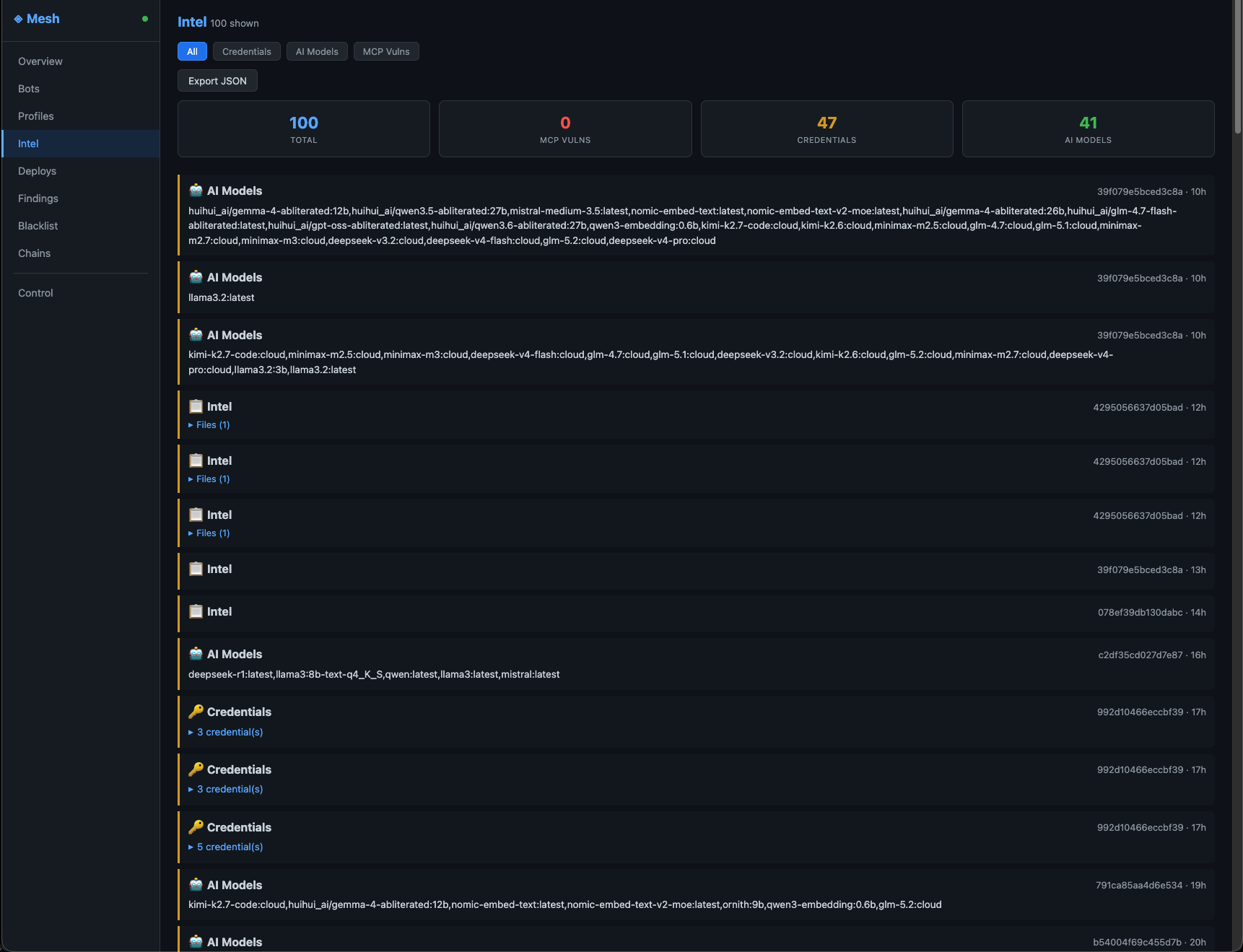
Intel Panel
The controller panel aggregates and displays the following categories of harvested data:
- Credential count: unique AWS AccessKeyIds
- MCP vulnerabilities: exploitable execute_sql / execute_shell services
- AI models: Ollama (llama2/mistral) + ComfyUI + Open WebUI
- K8s ServiceAccounts: cluster privilege tokens
- Environment variable credentials: credentials reusable across hosts
- Docker hosts: container hosts open to escape
IoC
C2
209.99.186[.]235
cdnorigin[.]net
Sample SHA1
31c69b3e12936abca770d430066f379ec1d997ec